One of the things I did regularly on my blog was share rewrites of museum labels. The three examples here show how to incorporate a range of best practices for exhibition text.
Example One
O Say Can You Synonym
My rewrite of this introductory panel was sparked by my blog post Sins and Synonymity: I wanted to eliminate a type of synonym use that is particularly confusing to English language learners.
While I was at it, I made a lot of other changes. I may have exceeded my brief; usually when I edit, I don’t change the tone or the voice quite so much. But when I looked at the mission of the institution hosting the exhibition (in contrast to the institution that loaned the collection items and presumably wrote the labels), my radical rewrite seemed not entirely inappropriate. And it was good exercise.
Original
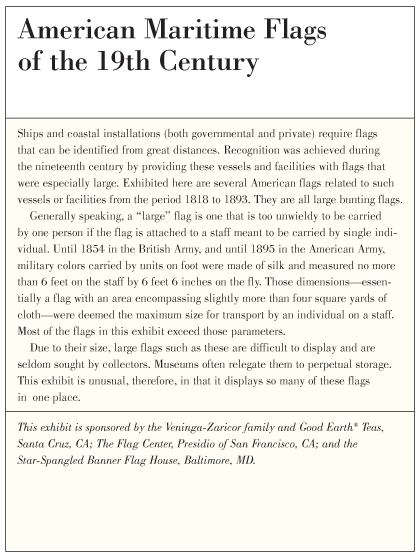
Rewrite
American Maritime Flags
of the 19th Century
The flags in this exhibit are very large! Why?
These flags were used on ships or at related coastal facilities. People had to be able to recognize these flags from great distances. During the nineteenth century, they made this possible by making the flags very big.
Flags from ships and coastal facilities are called maritime flags. The flags in this exhibit are American maritime flags from the period 1818 to 1893. These flags are all large bunting flags.
A flag is considered “large” if one person can’t comfortably carry the flag when it’s flying from a staff. In the 1800s, the Army thought a foot soldier could carry a silk flag that was as big as 6 feet tall by 6½ feet wide. Most of the flags in this exhibit are much bigger than that!
Because these flags are so large, they are difficult to display. Museums often leave flags like these in long-term storage. Seeing so many of these large flags in one place is an unusual opportunity.
Depending on which online readability rater you trust (if you trust any), I’ve brought the reading level down from somewhere around grade 11 to somewhere around grade 5. But that was incidental to my main aims: avoid “synonym sins,” and focus on what was special about these flags and this exhibit.
You might notice I left out quite a bit of information from the original label about the sizes of military colors that soldiers were believed to be able to carry. It didn’t seem relevant, since none of the flags in the exhibit were of that type. Plus, the information is hard to understand and makes the label a lot longer. But any good process of rewriting/editing is a negotiation, and if the original writer/curator felt the information was essential, I’d lobby for a sidebar or boxed element, ideally with an illustration to clarify. Even without the sidebar, an illustration could be a big help to this label. That definition of “large” is a bit unwieldy, even when you remove the word “unwieldy.”
Example TWO
An Unconventional Image

The original version of this label takes a long time to get around to explaining what’s special about this painting (why it’s important enough to be in a museum) and to refer to anything specific a viewer can see in the painting (information that can be especially helpful to art novices.) The information is all there, just not in the best possible order.
In the proposed rewrite, you learn immediately what is special about the painting (it’s an unconventional way to portray the subject matter). Each question raised (for example, what about it is unconventional?) is answered soon after (Mary is an adolescent; Mary has no halo).
Original

Rewrite
The Annunciation
1898
Oil on canvas
Henry Ossawa Tanner
American (active France)
Born 1859, died 1837
In The Annunciation, Tanner created an unconventional image of the moment when the angel Gabriel announces to Mary that she will bear the Son of God. Influenced by a recent trip to Egypt and Palestine, Tanner painted Mary as an adolescent dressed in rumpled Middle Eastern peasant clothing, without a halo or other holy attributes, and Gabriel as a shaft of light.
Tanner, the son of a minister in the African Methodist Episcopal Church, specialized in religious subjects, and traveled to the Holy Land to experience firsthand its light, architecture, culture, and people.
Tanner entered this painting in the 1898 Paris Salon exhibition. In 1899, it was bought for the Philadelphia Museum of Art, making it his first work to enter an American museum.
Example Three
David and Goliath
With this rewrite, my intentions were
- to make the label more coherent by keeping all the information on the fresco’s subject matter together
- to make it more readable by breaking the information into chunks and shortening one very long sentence
- to improve the flow by putting some parenthetical information in… parentheses.
(And my version is eight words shorter.)

Original

Rewrite
David with the Head of Goliath, circa 1618
Fresco
Giovanni Francesco Barbieri, called Il Guercino
Italian (Bolognese), 1591–1666
This early fresco by Guercino shows the biblical story of David, who, against all odds, killed the Philistine giant Goliath and beheaded him with the giant’s own sword.
Fresco is a technique in which paint is applied to fresh plaster. As the plaster dries, it bonds with the pigment. (A good portion of the tree on the right, however, was painted on top of the dry plaster, using pigments bound with glue or egg.)
Fresco painting was normally used for large-scale architectural decorations rather than smaller-scale works such as this. It is possible that Guercino did this painting as an exercise in mastering the fresco technique.